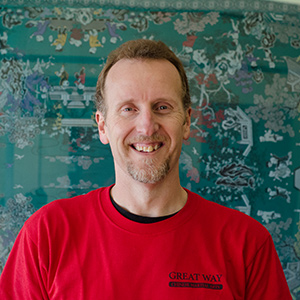
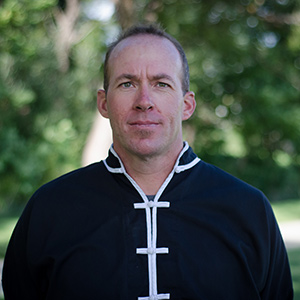
Sifu Keller began his martial arts training 25 years ago in the Bai Lung Kung fu / Tai Chi system of Master Daniel K. Pai. This opportunity served to build a strong foundation and understanding of Martial Arts, which he has enjoyed sharing with thousands of students.
He then expanded his studies in China where under Master Wang Pei Sheng he studied Xingyi, Yin Style Ba Gua and Wu style Tai Chi. Master Wang’s vast knowledge of Chinese Martial Arts and Chinese Medicine served as a pivotal time for Sifu Keller. He realized that the great Masters continually applied Martial Philosophy with Ancient Medical Philosophies.
In 2005, Sifu Keller received his Masters of Oriental Medicine from Southwest Acupuncture College. He has continued to refine his studies of classical medicine with practitioners such as Jeffery Nagel, a disciple of Share K. Lew. Sifu Keller enjoys a private practice where he treats patients with various types of illnesses.
Based on Sifu Keller’s exposure to different amazing Masters through the years he has drawn upon their knowledge and experience to refine his teaching and practice. His strong desire to continue their lineage in Ssu Tao Pai Kung fu expresses itself in numerous ways. The carefully constructed curriculum provides his students with a clear and safe path to develop themselves fully over the course of their training.
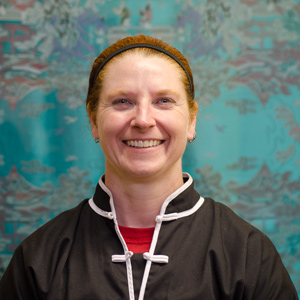
Hi my name is Simo Keller, I am married to Sifu Keller, and therefore I have the title of "Simo" which means instructor's wife. I have been practicing Kung fu, Tai Chi and Chi Gong for over 16 years with multiple trips to study with Master Wang Pei Sheng in China.
I love Chinese Martial Arts, it has been a passion for me ever since I decided that I needed something more....something that would satisfy my thirst to challenge my mind, my body, and my spiritual growth—which I continue to develop under the tutelage of my teacher and husband.
I love children, I have four of my own—which is why I believe in giving all of our kiddos attending Great Way a chance to find a nurturing environment where they can grow and develop not only physically, but also mentally. I help in all of the classes, but you will find me most often teaching the Tai Chi and Chi Gong Classes.
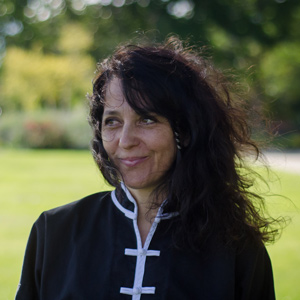
Much like Sifu Keller, Todai Newth began her martial arts training in 1989 with the Bai Lung Kung fu / Tai Chi system of Master Daniel K. Pai. She spent many years building her martial arts discipline within this system, and developing her martial understanding. During this time she was both a teacher and a student.
Todai Newth was blessed with the opportunity to study under Master Wang Pei Sheng in China where she learned Yin Style Ba Gua technique in the late 1990s.
In early 2012 Todai Newth sought out Sifu Keller as her personal teacher. Her practice expanded to include Tai Chi and Chi Gong, as well as the Ssu Tao Pai Kung fu system. During her time with Sifu Keller, her depth of martial understanding and understanding of herself has continued to develop, as well as her desire to serve the community through teaching children and adults martial arts, and ultimately the life skills that come with martial practice.
Martial arts training should be a multifaceted journey, appealing to Body, Mind and Spirit. Challenging us to grow and stretch in unique ways that we might live a more conscious and vibrant life.
FAQ
What should I eat before class?
The popular train of thought on what to eat before a workout is to “carbo load”. Carbohydrates provide energy (glycogen) for body. While carbs are important to build and maintain glycogen stores for workouts I have found that people tend to over do it. A diet that is too high in carbohydrates will not help shed the extra weight. I have found that when students focus on just carbs before a workout they leave the school starving and tend to binge to replenish glycogen (sugar) stores.
I suggest having a meal at least 1 hour before workout with 6-8 oz. of protein and a moderate amount of healthy carbs to maintain your energy levels throughout high intensity workouts. The protein is digested more slowly and you will be less hungry after working out. Carbs help maintain energy levels through your workout so you don’t crash during class.
How do I count from 1-10 in Chinese?
yee (ee)
uhr (er)
sahn (san)
suh (su)
woo (wu)
lyo (lee-oh)
chee (chi)
bah (ba)
jyo (jee-oh)
shi (sure)
What is La She She Kan?
Our ceremonial bow has martial application and should be performed as if you are fighting someone.
Break stance.
Pull the left fist to the hip (imagine elbowing someone behind you), the right hand comes to the center of the chest (knife edge forward) like prayer position. Bow slightly.
Step the right foot forward, pivot the foot to a 90 degree angle as the right hand becomes a fist the left hand covers as you support an elbow strike to the rear.
Step the left foot forward to a cat stance (just the ball of the foot is on the ground), the hands come in as you perform a strike to the center of the chest (hands are in Break stance position).
Step the left foot back to lunge stance, both hands block down groin level (as if your opponent is kneeing or kicking at your groin).
Step the right foot back so the feet are side by side as you do this the hands roll inward come up and out to perform a double back fist head level then the fists pull back to armpit height (elbowing to the rear again).
The hands will open slowly and push with tension to full extension at the sides (the use of tension and dragon hiss is the beginning of breath control).
The hands rise as they open, coming forward and outward slightly. They strike in a double ridge hand (right hits the temple, left hits the jaw), cross the middle line then pull back and elbow strike to the rear, fists end up under the armpits.
Break stance
What should I wear to class?
When you start classes it is important to wear comfortable clothing. Sweats, t-shirt and tennis shoes work well, being able to move around is the most important part.
How does the belt/sash system work?
Using a belt or sash to gauge rank is not a part of traditional martial arts. We use a sash system within our style to help our students understand and associate with what they are learning.
At each level there is a certain amount of information that must be learned before you test. It is not about passing the test, it is about understanding and applying what you learn.
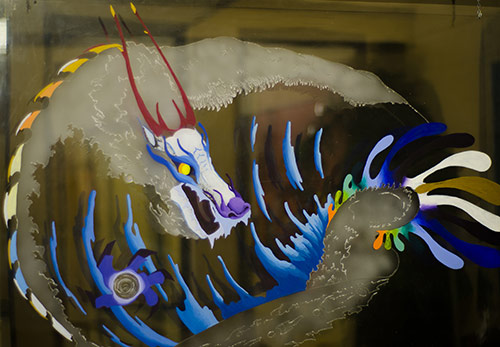
We start with a plain black sash to indicate our Beginner level. With each test we add fringe of different colors to show the new level that they have attained. The piece of art shown with this section shows the colors used for our sash fringes.
What do the different t-shirt colors mean?
We use different colored t-shirts to give an association to the different animals that we use in our logo (see the logo explanation to better understand this importance).
Am I required to buy a uniform?
No, it's not required, but it might make your life a little easier. It's nice to have dedicated workout clothes and to match the other members of Great Way, but it's not required.
Do I have to sign a contract?
No, we do not require a contract. If you are on a Monthly EFT (Electronic Funds Transfer) plan, we'll just need 30 days to cancel your account.
What is the difference between Kung fu and other major martial arts?
Kung fu is a broad term for the many types of Chinese martial arts. There are hard styles, soft styles, family styles and temple styles. Kung fu is typically known for its use of a wide variety of fighting techniques and stances. There is also the practice of “forms” which allows the student the opportunity to develop greater coordination, balance, control, stamina etc. Kung fu students also practice with traditional Chinese weapons.
Karate and Tae Kwon Do are typically known to be hard styles and have more linear movement. They also utilize katas (forms) to help students develop better control and skill.
Judo and Aikido work more specifically on throws and joint locks.
Jujitsu is known more for ground work or grappling and joint locks.
This is a very broad discussion and to be fair to other arts it would be beneficial to research them more deeply because this description is very generalized.
Something else on your mind?
In our digital, multi-tasking world, martial arts offers a welcome escape. Come in, chat with us. We're here to help. Personal relationships and community are a serious part of Great Way.